The Secret 80% of People Do Not Know

I am going to let you in on a little secret.  It may be the most actionable piece of information you ever hear for developing a champion athlete.  And if you really use the secret you’ll be doing things different than 80% of the people in youth sports.

The secret is to think in terms of Long-Term Development.  You see I would venture to say that 80% of people think about things in the short-term.  They think about doing well in the tournament next week or cramming in lessons and training right before the varsity tennis season starts.  They want results “right now” and are constantly looking for the short-term fix.  This is the reason you see junior players bounce from program to program and pro to pro.  When something is not working “right now” they think the answer is to make a short-term change.  This is the mentality of about 80% of people out there.

Long-Term Development

Now contrast that with a mindset of Long-Term Development.  This mindset is nothing more than planning from the very beginning for the long haul and mindfully aligning everything in an effort to reach that goal far off on the horizon.  It is characterized by a growth mindset, slow and steady progress, making little improvements each day, and not getting caught up in short-term successes and setbacks.

Planning for the long-term is not easy because it takes a great deal of wisdom and foresight.  In the world of tennis this would be taking a 7-year-old and developing him or her to become the best they can be at 20+ years of age.  Along the way taking no shortcuts and committing to believe and trust in the plan.  In my experiences those who have had the most success were also those who committed to the idea of long-term development from the very beginning.

If you think about it, regardless of the sport, you are really only competing against 20% of everyone involved.  Right off the bat, about 80% of the people are only focused on the short-term and that means in the long-term they really have no chance to do something special.  If you have the mindset of long-term development, you are only competing against the other 20% of people who are thinking the same way as you.

Having the mindset of long-term development will give you the edge when it matters most in an athletes career.


Mountain of Player Development

I just recently sat down with two parents and a young man to discuss moving into the world of tournament tennis.  In that conversation I compared climbing a mountain to developing a tennis player and I am going to share the same analogy with you.

Player Development Mountain

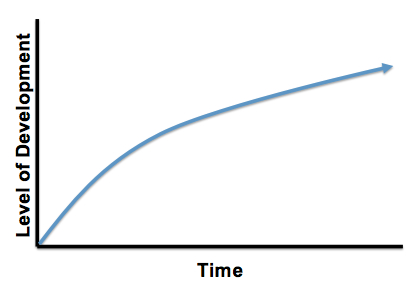
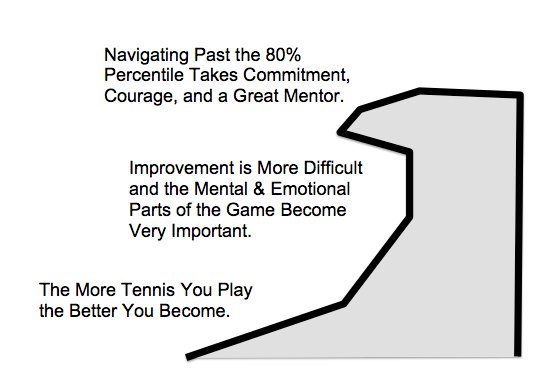
At first climbing a mountain is easy,  the slope is not very great and you can cover a lot of ground quickly.  The same is true in tennis,  when you first begin your journey the concept is simple, play a lot of tennis.  The more balls you hit, lesson you take, clinics do, and matches you play the better you become.  There is a direct relationship between the time invested and rate improvement.  Tennis is a repetition sport and you cannot skip past putting in the time no matter how good the instruction.  Quantity is important but I should make a point to say in moderation.  If a 7-year-old is playing 80 hours of tennis a week that is not good for their long-term development.

As a climber makes his way further up the mountain it becomes more and more difficult to make progress.  The same is true for tennis players.  Eventually there comes a point where hitting more and more tennis balls has a rate of diminishing returns.  This is a big sticking point in a player’s development.  At this point in time the level of instruction a player is getting is of paramount importance.  In order to continue to climb and improve mental and emotional skills must be developed.

Mental skills are concepts like shot-selection, routines between points, and momentum management.  Emotional skills revolve around understanding match-ups, balancing respect for an opponent, and overcoming the pecking order.  Players at this level must work both incredibly hard and smart.  Working hard alone is not enough to continue climbing the mountain of improvement.  At this stage progress is slow and as Coach Chuck Kriese says,  “The work a player does here pays off 6 months or a year from now.”

If a player makes it this far up the mountain they are better than 80% of the people in the world who play tennis and continued improvement is just as difficult as getting past an overhanging ledge right before you reach the summit of the mountain.

When someone climbs Mt.Everest they hire a guide because the guide has been to the summit and know the best path to get there.  The same is true for a tennis player in the last leg of his or her development, they need a guide.  Getting past that overhang is incredibly difficult and it takes good coaching, mentoring, and role-models who know the way.  Certainly a player could go out and make it on their own with no guidance just as someone could summit Everest without a guide.  However, having a knowledgeable mentor at this difficult to navigate pass saves a tremendous amount of time and costly mistakes.

Let me know what you think about this analogy in the comments below and if you are looking for a place to get in the repetitions early in your journey or develop mental and emotional skills to continue your progress consider my Summer Tennis Camp.  If you are at the overhang send me an email and I’ll put you in touch with a world-class mentor.


The Strength Deficit as it Relates to Tennis

WeddingMy wife and I workout together in our cozy little home basement gym.  She has been crushing it for some time now and getting strong!  She normally doesn’t ask too many questions and just does what I program for her.  And I do have a method for programming workouts that involves what I am about to tell you about.

However, the other day she decided to do one of those follow-along video workouts. There was a lot of plyometric jumps involved which sparked some conversation over dinner about a little known concept called the Strength Deficit.  I am going to simplify the concept for you and if you are a tennis player it is absolutely critical to maximizing performance through off court training.

There are two kinds of strength you need to understand before we can move on to defining the strength deficit.

The first type is Absolute Strength.  This kind of strength is the absolute maximum amount of contractile force a muscle is capable of producing involuntarily.  In a laboratory setting we could stimulate your nerves with an electrical impulse causing the muscle fibers to contract.  In doing this experiment one could theoretically measure the absolute maximum contractile force your muscles are capable of producing.  Absolute strength is closely related to the size of the muscle fibers.  In other words, the larger the muscle is the greater the absolute strength potential.

The second type of strength is the Competitive Maximum.  This is the maximum amount of contractile force a muscle can produce voluntarily.  In other words this is the force you are capable of creating under your own control.  The competitive maximum is related directly to your central nervous system (CNS).  The stronger the impulse your can send through your nerves to the muscle fibers the more forcefully you can get them to contract.

So now that you understand that the absolute maximum is involuntary and the competitive maximum is voluntary we can get to the Strength Deficit.  The strength deficit is simply the difference between the two.  It should be noted that the absolute strength will always be higher than the competitive maximum because you will always be able to involuntarily contract muscle fibers to produce more strength compared to what you can do voluntarily.

Strength Deficit

What the strength deficit tells an athlete about their current state is amazingly insightful.  And if you know how to interpret the information it gives you a roadmap for how to continue making strength gains.

Here is how to interpret the strength deficit…

If the competitive maximum is close to the absolute strength you have a small strength deficit. A small deficit means that an athlete is able to send strong messages to the muscles and stimulate a strong contraction.  This is a very good sign because it means they are capable of utilizing most of their capacity for strength.  If an athlete with a small strength deficit wants to improve they need to focus their efforts on muscle hypertrophy or growth in order to raise the level of absolute strength.

If the competitive maximum is further from absolute strength you have a large strength deficit.  This means the potential for strength is there but the CNS is not capable of creating a strong enough signal to excite the muscle fibers to utilize it.  This tells an athlete they have room for strength gains without putting on more muscle.  Gains can be made by specifically designing explosive training sessions to stimulate CNS development.  Focusing on gaining more muscle mass will only increase absolute strength and the strength deficit further.

Now before I go any further the strength deficit is a fairly advanced concept and I do not want you running out and applying this to kids or beginners.  You really need to know what you are doing and this is just a overly simple blog post explaining the bigger concept.  If you want more information I recommend reading a highly complex book translated from the work of Russian Sport Scientist Yuri Verkhoshansky, Super Training.  With that being said if you are just getting started lifting weights you will see improvements in both absolute strength and competitive maximums quickly.  Beginners just have more room to make adaptations and improve.  However, if you are hitting plateaus, it is a good idea to look at your strength deficit and see if you should focus your efforts on gaining more muscle size and absolute strength potential or finding ways to stimulate the CNS and its ability to maximize muscle fiber contractibility.

Now think about a competitive tennis player’s needs…

First, tennis players need explosive and powerful muscle contractions.  They need to swing the racket with amazing accelerations and speed.  Players need to be able to sprint, change directions, and reaccelerate again.  These skills require a great deal of power without having an enormous body building style muscular frame that can slow an athlete down.  By now you should be able to guess that tennis players should have a small strength deficit.  Tennis players want to be able to maximally contract the muscle fibers they have.  That is not to say that there is never a time to build bulk and absolute strength because there is.  However, once muscle hypertrophy or mass is gained it should be followed up with a block of training to stimulate the CNS to utilize that new found strength potential fully.  Players like Djokovic, Nadal, and Federer are incredibly strong and I would bet they also have a small strength deficit.

Questions or comments leave them below and I will be happy to answer them.


720 Degree Coaching – Radio Interview

I was the featured guest on Bill Patton’s 720 Degree Internet Tennis Radio Show.  Bill Patton is a coaching friend from the West Coast and it was an honor to talk about how I got involved with the game, coaching philosophies, and share information about my tennis training camps.

Popular Goals Internet Radio with 720 Degree Coaching on BlogTalkRadio

Tennis is Real-Life Flappy Birds

Tennis is arguably the most difficult sport of all to become very good at.  At the higher levels of the game it takes tremendous athleticism, technical proficiency, mental capacity, and emotional toughness.  Who in the world would want to pursue something that is so difficult?

I was recently talking with a kid about this iPhone game called Flappy Birds.  It is notorious for being extremely difficult.  It also is known for being one of the most downloaded apps ever and one of the most addictive.

Flappy Birds Screen Shot

After I played the game I found myself very intrigued and deep in thought.  You see this game is different than most because it is so difficult.  Kids will give up or get bored in 15 minutes or less with easier games but not Flappy Birds.  It is the level of difficulty that makes it fun.

You see the real fun is not being successful.  Things that are easy to achieve success with get boring quickly.  The real fun is in pursuit of achieving success with something that is difficult.  I know in my life the things that have been the most fun and fulfilling have been the things that have been the most difficult.

Tennis is the real-life version of Flappy Birds.  It is the pursuit of excellence on the tennis court that makes it so much fun.  In the process it also teaches tremendously valuable life-long lessons.

Think about registering your child for Summer Tennis Camp and I think you will find that once they pick up a racket it will be hard for them to put it down.


Why is Movement Paramount in Tennis?

Movement on the tennis court might be the most important aspect of the modern game.  That is a bold statement considering the overwhelming majority of players spend most of their practice time focusing exclusively on technique.

Consider these figures…

Singles Court Dimensions78′ by 27′ are the dimensions of the singles court.

A ball that is traveling at 60 miles per hour is moving at a rate of 88 feet per second.  That means if you hit the ball down the line at 60 mph it gets there in less than a second, assuming it has enough topspin to keep it inside the lines.

Since the NFL started implementing electric timing of the 40-yard dash the record holder is Chris Johnson.  He ran the 40-yard dash in 4.24 seconds, which equates to moving at a rate of 28.3 feet per second.

If we put Chris Johnson, who owns the fastest 40-yard dash, on the singles sideline and hit the ball down the line at 60 mph he would make it just before the ball got there!

Think about the implications of all these numbers.  Johnson obviously possesses world-class speed and he is just barely making it there in time.  What about younger athletes who are not at the world-class level of speed?  Also consider that 60 mph ball down the line is not even that fast considering there are professionals striking the ball well in excess of 100 mph.  Andy Murray hit a blistering forehand at 124mph in Cincinnati last summer!

Naturally as players improve the speed at which they rally from the ground increases.  The technology of rackets and strings also continue to enhance the speed at which players can hit the ball.  This is all wonderful until the rally tempo becomes so fast the athlete can no longer get to balls.  It is absolutely critical for developing players to improve both their movement and ball striking skills in unison.  Tremendous ball striking skills are great if you can literally hit so fast that you can blow an opponent off the court.  When an opponent has fairly equal ball striking ability the difference is movement.  The player who moves better is the one who will perform better.

This ball striking and movement conundrum is often very apparent in the younger age divisions of junior tournament play.  In the younger age groups typically the players who are the best ball strikers tend to win the most.  However, as age progresses, other players “catch up” and ball striking skills tend to level out.  This is the point where the players who move well now have the advantage.  Many times the players who were successful in the younger age categories try to compensate in the older groups by attempting to hit the ball harder.  The problem is you can only hit the ball so hard and it is a scenario of diminishing returns.  Their time would be better spent improving movement around the court.

I tell players they are in a race with the ball.  If a player beats the ball there, then they have the opportunity to return a high quality shot.  If a player gets there at the same time as the ball, they will not be able to setup and end up hitting a weak reply.  Finally, if the ball beats them there then obviously they lost the point.

You cannot defy the laws of physics and the math above proves it.  So what are the keys to moving well on the court?  Have an explosive first step, proper recovery positioning, good anticipatory skills, be able to hit open-stance on both sides, and have efficient footwork patterns that facilitate both quickness and maximize ball striking.


Hate to Lose

Chris Everet Quote

I was reading a book and the quote above was in it.  I read it over and over again…  What a powerful quote by 18-time grand slam champion and world #1 Chris Evert!

You see champions love to win.  Champions relish in the pressure, rising to the occasions in the big moments, and arising victorious.  However, as much as champions love to win they hate to lose even more.  The pain of losing is the greatest motivator of a champion.  When a champion trains or prepares for competition they are not motivated by the pleasure of winning, instead they are motivated by avoiding the pain of losing.

I have seen some real tantrums after tough losses in my time.  I understand the pain of the loss and the pain is important because it is a great teacher.  However, it is important for players to understand that all great champions hate to lose, but those who are truly great do not make a poor public display after a defeat.  Champions like Federer and Nadal certainly hate to lose and I am sure it burns them up inside but you never see them throwing a fit after tough losses.

Read and reread the quote above and let the power of it really sink in…


How Deep is Your Desire?

I saw this video earlier today and to put what I saw into words does not do it justice, so just watch it…

I wrote about the 3 ingredients necessary for success (Ability, Desire, & Opportunity) before.  The man in this video Dustin Carter is amazing to say the least.  He reminds us all that desire, which is controlled by the individual, is the most critical piece of success.  When you have a burning desire to “Want To” accomplish something, figuring out “How To” accomplish it falls right into place.  Thank you Dustin for the reminder that it takes desire to maximize the abilities we are born with and the opportunities that are afforded to us.


Internal vs. External Motivation

AppleTVI bought AppleTV for my wife over the holidays but I it turned into more of a present for myself than her I think…

If you have AppleTV go to the “HBO to Go” app and watch the 1981 classic Chariots of Fire while it is available.  I have watched it a few times and I did so again this morning, which led to the inspiration of this post.

Chariots of Fire is a deep movie that tells the true story of two athletes, Harold Abrahams and Eric Liddell, who both achieve a gold medal for their sprinting at the 1924 Olympic Games.  The interesting part of the movie is what drives each to compete.  Harold is driven externally by a need to win and Eric is driven internally by expressing his inner-self through running.

So how does this all relate to tennis?  When a player makes a decision to commitment to put their all into tennis they can do so by being motivated externally or internally.  Either means of motivation is necessarily better than the other.  Champions athletes have both been motivated either externally or internally as is the case with both gold medalists in the movie.  However, there are distinct differences that arise when an tennis player is motivated externally versus internally.

When a player makes a commitment through external motivation they are driven by a product such as winning or playing #1 on the team.  Often times what can happen when a player is driven by product is that they validate who they are based on their results.  They wrap their entire self-worth up in winning and losing.

In the movie Harold was so obsessed with winning the gold medal when it came time to compete the fear of either winning or losing was tremendous.  Preparing for the competition was filled with stress and anxiety.  The whole process was filled with the feeling of burden.  These feelings all make sense when you look at how Harold’s self-worth was wrapped up in the future results.  When he did win the gold medal it was not very fulfilling,  In fact, winning was more of a relief and feeling that a burden was lifted than a joy.  These same feelings can happen to tennis players as well who are driven by the product of winning.

On the other hand Eric Liddell was driven by internal motivation.  Sprinting was not a way to validate himself, instead it was the means of expressing his inner-self.  Training and competition were fun and joyous experiences.  Winning the gold was an incredible satisfaction and filled with happiness.  Losses were certainly disappointing but the joy came from the process of training and competing even when the product was not attained.  These same feelings can happen to tennis players who looks at tennis as the means with which to expression themselves.

If you are a player go watch Chariots of Fire and I bet after reading this you will see the depth and brilliance of a movie made 32 years ago.  If you are a parent sit down with your children and use this movie as a great teaching experience.


Developing Leadership in 2014

Some of my reading list.

Some of my reading list from 2013.

If you know me personally you get how deeply I reflect on my coaching, the impact I have on the lives of those I teach, and am downright obsessive (my wife’s words, not mine) about learning and personal growth.  In this post I want to share with you one of my coaching goals for 2014, developing leadership.

For me sports have always been a metaphor for life.  All those little cliches and motivational phrases ring so true to me.  Wining is certainly nice but victories are short-lived and many times unfulfilling.  In fact, I think winning is really just a by-product of a deeper process of a growth mindset.

Let’s be real for a minute and face the facts that it is difficult to make a living playing professional tennis and college scholarships are not even a sure thing as competition with international students is fierce.  I believe most parents know this and do not get their children involved in tennis, at least initially, for the fame, glory, and scholarships.  I believe parents get their children involved in tennis because it teaches them so many valuable life lessons.  I wrote about this many times before and most of the parents I talk to think it is true as well.  What I find interesting is that my reasons for getting into coaching was to teach the very same lessons parent’s initially were seeking.

Do not get confused, I certainly have the knowledge and skills to help players develop on the court, turn into better athletes, and achieve performance goals.  However, in the process of developing those attributes I find deeper lessons are taught that are invaluable in the lives and performance of young people.  I truly believe that if the work I was doing had no effect on a young person’s life besides just improving forehands and conditioning my passion would fade very quickly.

I saw and still do see a tremendous opportunity to use sports and tennis in particular to develop leadership qualities in young athletes.  In my relentless quest I have spent the better part of this past year studying leadership, in particular the works of Dr. Tim Elmore and a non-profit called Growing Leaders.  Dr. Elmore has an elegantly simple manner in which he uses word-pictures to get complex and profound messages about leadership across.  And if you know me I am all for analogies!

An example of one of Dr. Elmore’s images is that of an iceberg.  10% of the iceberg is above the surface of the water and is what everyone sees.  90% of the iceberg is below the surface of the water and is the part that no one sees.  Take that image an explain to a young athlete that they are the iceberg and the 10% that people see represents their skills.  The 90% people do not see is their character.  It is character that makes up the biggest part of who they are as an athlete and a person.  There are many athletes who have the skill that everyone sees but are missing the character that keeps them grounded.  It is pretty easy to turn to any professional sport and find examples of athletes with tremendous talent and little character and integrity.  In fact, an iceberg with little under the surface is known as a “growler” and is very easy to push in any direction because it lacks mass.

This is just an example of one of many lessons and images I plan to incorporate into my coaching in 2014.  I have found that a combination of great coaching of the technical skills and fitness brings a player along very quickly.  But when a coach begins developing a player as a person real magic happens.  First, players realize very quickly that a coach cares about them as a person and as the old saying goes, “no once cares what you know, until they know you care.”  Second, players begin to look at their whole life differently, including why they play the sport to begin with.  When a young athlete finds a deep personal meaning in why they play a sport  good things are going to happen, regardless of the win/loss record.

I’d love to know what you think in the comments below.  And if you are an athlete, parent or coach interested in learning more about developing leadership I strongly recommend the Habitudes Series by Dr. Tim Elmore.  The books are very easy to read yet profoundly meaningful.